Private Jet Types & Sizes Explained
Private jets are grouped into classes by cabin size and range, from a six-seat turboprop to a fifty-seat VIP airliner. The class you charter sets two things at once: how many people travel and how far you fly nonstop. This guide covers every category on that scale, turboprop, very light, light, super light, midsize, super midsize, heavy, ultra-long-range and VIP airliner, with realistic passenger counts, range, cabin dimensions, and the example aircraft we arrange most often. The industry also calls these business jets — see our guide to business jet charter.
We are a charter brokerage. We arrange these aircraft through certified operators across Europe; we do not operate them ourselves. That means we recommend the right class for your route and party rather than the one we happen to own, whether you are weighing a class for a single leg or planning private jet charter in Europe more broadly. Every category below links to the bookable aircraft in our full fleet.
The private jet types at a glance
- Turboprop: 6 to 9 seats, short hops up to roughly 1,600 nm, the value floor of private aviation.
- Very light jet (entry-level jet): 4 to 5 seats, short jet trips up to about 1,300 nm, your first step from turboprop to pure jet.
- Light jet: 6 to 8 seats, up to roughly 2,500 nm, the European charter workhorse.
- Super light jet: 6 to 8 seats, around 2,000 to 3,000 nm, a light cabin with near stand-up height.
- Midsize jet: 6 to 9 seats, 2,300 to 3,000 nm, the first true stand-up cabin.
- Super midsize jet: 8 to 10 seats, 3,000 to 4,000 nm, the most balanced cabin in aviation.
- Heavy jet: 10 to 14 seats, 3,500 to 5,000+ nm, large-cabin long-haul comfort.
- Ultra-long-range jet: 12 to 16 seats, 6,000 to 8,000 nm, nonstop between continents.
- VIP airliner: 18 to 50+ seats, an airliner converted to a flying private space.
Helicopters sit alongside this scale rather than on it: they handle the final miles and the city-centre transfers a fixed-wing aircraft cannot. We cover them at the end.
Private jet sizes compared: cabin dimensions by class
Seats and range tell you what a class can do; cabin dimensions tell you what the hours inside it feel like. The figures below are main-cabin measurements for one benchmark aircraft per class — the tail we most often place in that category.
| Class | Benchmark aircraft | Cabin height | Cabin width | Cabin length | Standing room |
|---|---|---|---|---|---|
| Turboprop | Pilatus PC-12 | 1.47 m (4 ft 10 in) | 1.53 m (5 ft 0 in) | 4.40 m (14 ft 5 in) | Seated |
| Very light jet | Embraer Phenom 100 | 1.47 m (4 ft 10 in) | 1.49 m (4 ft 11 in) | 3.35 m (11 ft 0 in) | Seated |
| Light jet | Embraer Phenom 300 | 1.50 m (4 ft 11 in) | 1.55 m (5 ft 1 in) | 5.23 m (17 ft 2 in) | Stand-or-stoop |
| Super light jet | Pilatus PC-24 | 1.55 m (5 ft 1 in) | 1.69 m (5 ft 7 in) | 5.17 m (17 ft 0 in) | Near stand-up |
| Midsize jet | Cessna Citation XLS+ | 1.73 m (5 ft 8 in) | 1.68 m (5 ft 6 in) | 5.66 m (18 ft 7 in) | Stand-up for most |
| Super midsize jet | Bombardier Challenger 350 | 1.83 m (6 ft 0 in) | 2.19 m (7 ft 2 in) | 7.25 m (23 ft 9 in) | Full stand-up |
| Heavy jet | Bombardier Challenger 650 | 1.83 m (6 ft 0 in) | 2.49 m (8 ft 2 in) | 8.66 m (28 ft 5 in) | Full stand-up |
| Ultra-long-range jet | Gulfstream G650ER | 1.91 m (6 ft 3 in) | 2.49 m (8 ft 2 in) | 14.27 m (46 ft 10 in) | Full stand-up, multiple zones |
| VIP airliner | Airbus ACJ320 | 2.20 m (7 ft 3 in) | 3.70 m (12 ft 2 in) | 27.50 m (90 ft 3 in) | Walk-around |
Height is the dimension that changes a flight most. Up to about 1.55 metres you are seated or stooping from door to door. At the 1.73 metres of a midsize cabin most passengers stand without thinking about it, though anyone near six feet still ducks a little. The 1.83 metres of a super midsize or heavy cabin is the point where height stops being a consideration for almost everyone, which is why that step reads as a change in kind rather than degree.
The ladder is not strict. The Pilatus PC-24 is a super light aircraft with a cabin wider than the midsize Citation XLS+ and marginally shorter than the light Phenom 300: classes describe capability and cost, not a tidy size order. These are main-cabin figures, so they exclude the cockpit and the baggage hold, and they move by a few centimetres between individual tails depending on the completion. Treat them as the shape of a class rather than the spec sheet of one aircraft.
Turboprop
The turboprop is where private aviation starts. Propeller-driven rather than jet-powered, it trades top speed for low operating cost and the ability to use short and unpaved runways that jets cannot.
- Passengers: 6 to 9
- Range: 1,000 to 1,600 nm (roughly 3 to 4 hours)
- Cabin: enclosed, comfortable for short to medium legs, a lavatory on most tails
- Typical use: regional trips across Europe, and access to small airfields
Example aircraft we arrange include the Pilatus PC-12, the Beechcraft King Air 350, and the Cessna Grand Caravan for the roughest strips. See the full class on our turboprops page. Cost is quoted per trip; request a quote.
Very light jet (entry-level jet)
The very light jet, often sold as the entry-level jet, is the first pure jet on the scale. It brings jet speed and cabin pressurisation to short trips, at a cost close to a turboprop.
- Passengers: 4 to 5
- Range: 1,000 to 1,300 nm (roughly 2 to 3 hours)
- Cabin: seated, club or facing seats, a refreshment centre and a partitioned lavatory on most models
- Typical use: a fast pair or small group on short European legs
Example aircraft include the Embraer Phenom 100EV, the HondaJet Elite and the Cessna Citation M2. See the entry-level jets page. Cost is quoted per trip; request a quote.
Light jet
The light jet is the workhorse of European charter and the class most short and medium trips settle on. It carries a small group in comfort and reaches most of the continent in a single hop.
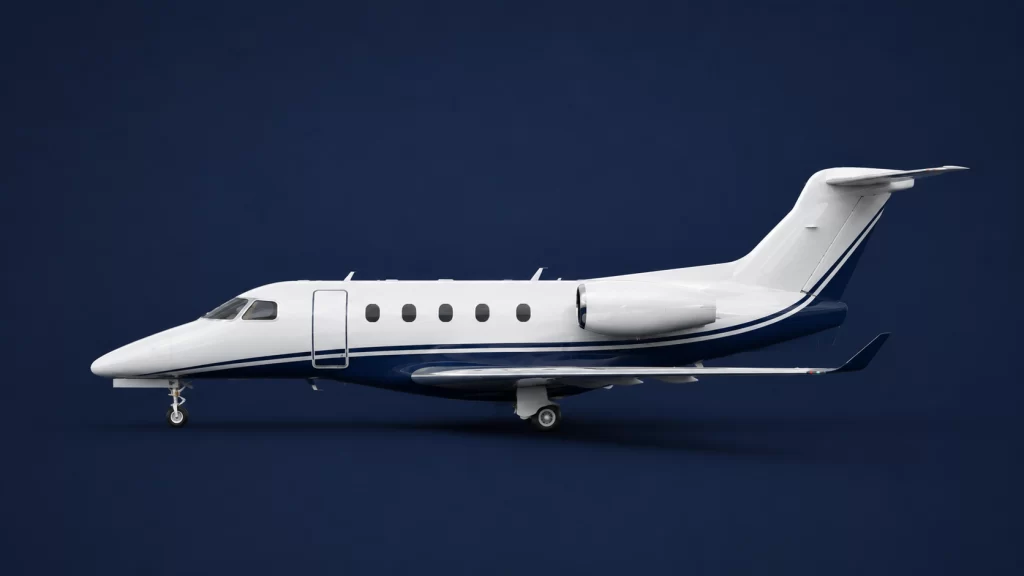
- Passengers: 6 to 8
- Range: 1,500 to 2,500 nm (flights up to roughly 3 hours)
- Cabin: stand-or-stoop, club seating, a refreshment centre and an enclosed lavatory
- Typical use: London to Geneva, Paris, Rome or Vienna with room to work
Example aircraft include the Embraer Phenom 300, the best-selling light jet for over a decade, alongside the Cessna Citation CJ4 and the Bombardier Learjet 75. See the light jets page. Cost is quoted per trip; request a quote.
Super light jet
The super light jet bridges the light and midsize cabins. It keeps light-jet airport access and running cost while adding range and close to full standing height.
- Passengers: 6 to 8
- Range: roughly 2,000 to 3,000 nm (4 to 6 hours)
- Cabin: near stand-up, club seating, an enclosed lavatory and a small galley
- Typical use: longer European legs where a light jet would feel tight
Example aircraft include the rough-field-capable Pilatus PC-24, the Embraer Phenom 300E, and the Cessna Citation CJ4. See the super light jets page. Cost is quoted per trip; request a quote.
Midsize jet
The midsize jet is the first cabin you can stand up in down the full aisle. It is the natural choice once a trip needs a real galley, an enclosed lavatory and room for a full party with baggage.
- Passengers: 6 to 9
- Range: 2,300 to 3,000 nm (roughly 4 to 6 hours)
- Cabin: stand-up, club seating with a refreshment galley and an enclosed lavatory
- Typical use: a full cabin across Europe, North Africa or the near Middle East
Example aircraft include the Cessna Citation XLS+, the flat-floor Citation Latitude, and the long-legged Embraer Praetor 500. See the midsize jets page. Cost is quoted per trip; request a quote.
Super midsize jet
The super midsize is the most balanced cabin in private aviation, and the class we arrange more than any other. It crosses a continent nonstop in a stand-up cabin, at meaningfully less than a heavy jet costs to run.
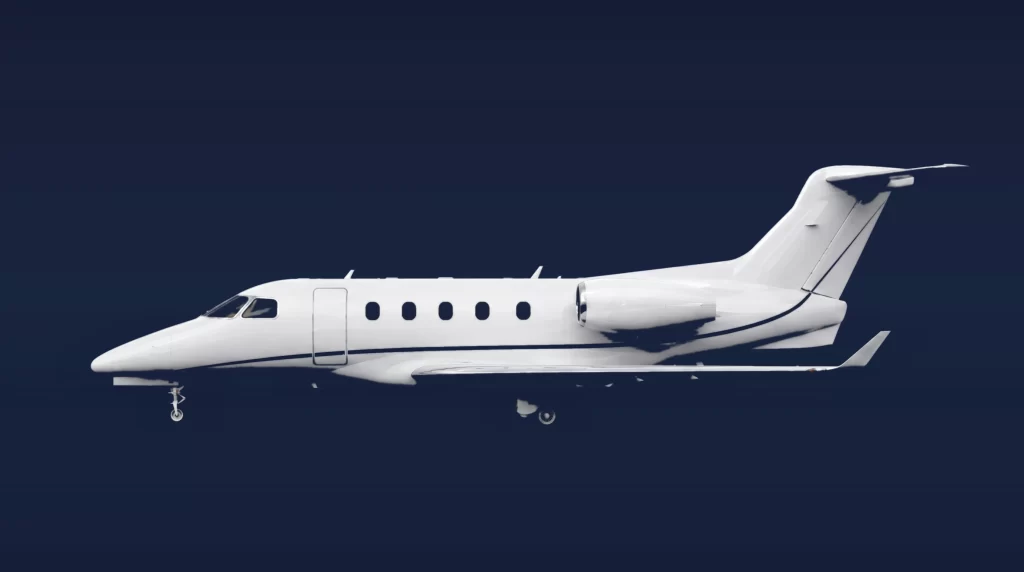
- Passengers: 8 to 10
- Range: 3,000 to 4,000 nm (roughly 6 to 8 hours)
- Cabin: stand-up, club seating with a full galley and an enclosed lavatory
- Typical use: transcontinental Europe, North Africa and most of the Middle East nonstop
Example aircraft include the category-benchmark Bombardier Challenger 350, the long-range Embraer Praetor 600 and Gulfstream G280, and the fast Cessna Citation Longitude. See the super midsize jets page. Cost is quoted per trip; request a quote.
Heavy jet
The heavy jet, also called the large-cabin jet, is built for long-haul comfort. It carries more passengers and baggage in a cabin you can move around, often with a separate zone for rest.
- Passengers: 10 to 14
- Range: 3,500 to 5,000+ nm (roughly 8 to 11 hours)
- Cabin: large-cabin, stand-up, full galley, enclosed lavatory, often a separate cabin zone
- Typical use: a full party long-haul, with genuine room to rest and work
Example aircraft include the wide-cabin Bombardier Challenger 650, the Gulfstream G450 and G550, and the short-field Dassault Falcon 900LX. See the heavy jets page. Cost is quoted per trip; request a quote.
Ultra-long-range jet
The ultra-long-range jet is the longest-reaching class in private aviation. It flies between continents nonstop in a multi-zone cabin, with a private bedroom and a shower on the largest tails.
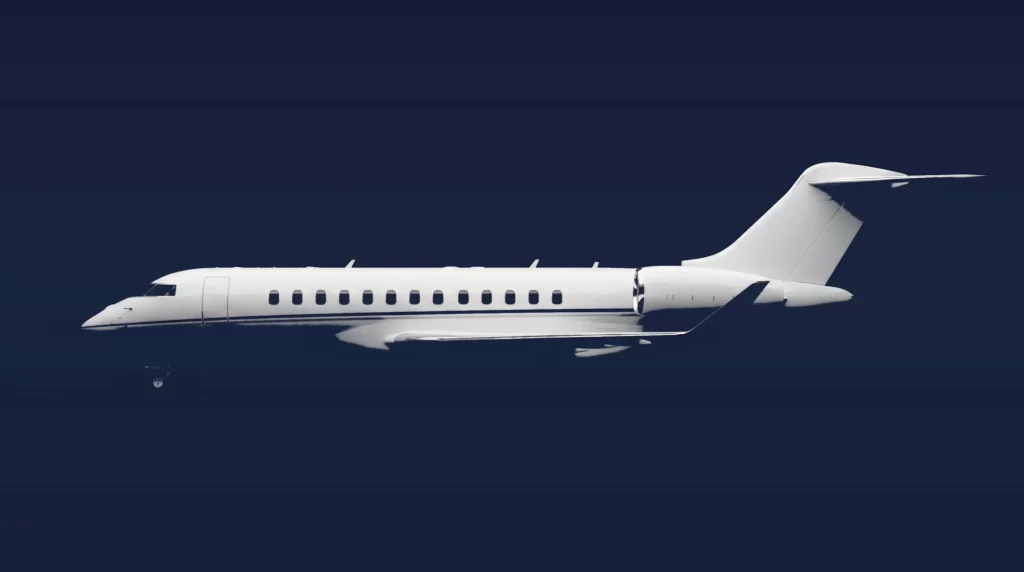
- Passengers: 12 to 16
- Range: 6,000 to 8,000 nm (roughly 13 to 16 hours)
- Cabin: full stand-up cabin in multiple zones, with a master suite on the largest aircraft
- Typical use: Europe to the US west coast, Asia or southern Africa without stopping
Example aircraft include the benchmark Gulfstream G650ER, the Bombardier Global 7500 with its full master suite, and the short-field Dassault Falcon 8X. See the ultra-long-range jets page. Cost is quoted per trip; request a quote.
VIP airliner
The VIP airliner is an airliner airframe converted to a flying private space. It is the class for a large group, a corporate roadshow or a head of state: an aircraft you walk around rather than sit across.
- Passengers: 18 to 50+
- Range: 4,500 to 7,000 nm (transcontinental to intercontinental nonstop)
- Cabin: walk-around airliner cabin with private zones, from staterooms to conference and dining space, plus a full galley and crew rest
- Typical use: large delegations and full-cabin intercontinental travel
Example aircraft include the Airbus ACJ319 and ACJ320, the Boeing BBJ, and the compact Airbus ACJ TwoTwenty. See the VIP airliners page. Cost is quoted per trip; request a quote.
Helicopters: the final miles
A helicopter is not a point on the size scale; it solves a different problem. It flies city-centre to city-centre, connects a private jet to a destination with no nearby runway, and handles offshore and scenic work. We arrange them alongside fixed-wing charter, often as the first or last leg of a jet trip.
Example aircraft include the Airbus H125, the Bell 429, the Leonardo AW109 and the Airbus H145. See the helicopters page. Cost is quoted per trip rather than by a published hourly rate.
Which private jet type is right for your trip
The right class comes down to three questions: how many people, how far nonstop, and how much cabin you need for the time in the air.
- Two to five people, short European legs: a turboprop or very light jet does the job for the least money.
- Six to eight people, most of Europe: a light or super light jet is the everyday choice.
- A full cabin that needs to stand up and work: a midsize or super midsize jet.
- Long-haul with room to rest: a heavy jet, or an ultra-long-range jet for a genuine nonstop between continents.
- A large group or delegation: a VIP airliner.
- No runway near the destination: add a helicopter leg.
For a side-by-side on cabin height, range and price across the most-chartered classes, see which cabin to choose. If you are unsure, tell us the route and party and we will match the aircraft to the trip.
What the different types cost
Cost rises with the class, but a larger aircraft is not always more expensive for a given trip, because a longer-range jet can fly nonstop where a smaller one needs a costly fuel stop. The real number for any trip depends on the specific aircraft, the routing, repositioning, and crew and landing fees.
For how charter pricing is actually built up, see what charter costs. We quote every trip individually rather than from a rate card.
Request a quote · See our full fleet
Frequently asked questions
What are the main types of private jets?
Private jets are grouped into classes by cabin size and range: turboprop, very light (entry-level), light, super light, midsize, super midsize, heavy, ultra-long-range, and VIP airliner. Helicopters sit alongside this scale for short city-to-city and final-mile flights.
What is the difference between light, midsize and heavy jets?
A light jet seats six to eight for short to medium European trips with a stand-or-stoop cabin. A midsize jet adds full standing height, a galley and more range. A heavy jet is a large-cabin aircraft for long-haul flights with ten to fourteen passengers, a separate rest zone and the highest comfort.
What is the smallest type of private jet?
The very light jet, or entry-level jet, is the smallest pure jet: typically four to five seats and short-haul range, such as the Embraer Phenom 100 or the HondaJet. Below that, a turboprop carries more passengers over short distances at a lower cost, using a propeller rather than a jet engine.
Which private jet has the longest range?
The ultra-long-range class flies the furthest nonstop: 6,000 to 8,000 nautical miles, reaching from Europe to the US west coast, Asia or southern Africa without a stop. The Gulfstream G650ER and the Bombardier Global 7500 lead the class.
How do I choose the right private jet type?
Start with passenger count and the longest nonstop leg you need, then add the cabin comfort the flight time calls for. We match the class to your route and party, and will tell you plainly when a smaller and cheaper aircraft serves the trip just as well.
What size is a private jet cabin?
It depends on the class. A very light jet cabin is roughly 1.47 metres high, 1.49 metres wide and 3.35 metres long — seated space for four or five people. A midsize cabin such as the Citation XLS+ runs to about 1.73 metres high and 5.66 metres long, which is where most passengers stand without stooping. An ultra-long-range cabin like the Gulfstream G650ER’s is about 1.91 metres high, 2.49 metres wide and 14.27 metres long, with room to stand and to sleep in a separate zone.
Which private jets have a stand-up cabin?
Midsize jets and everything above them. The Cessna Citation XLS+ cabin is about 1.73 metres high, which clears most passengers though not a six-footer; super midsize and heavy jets run to roughly 1.83 metres, where almost nobody ducks, and ultra-long-range aircraft to about 1.91 metres. Light and very light jets sit near 1.47 to 1.50 metres, which is stand-or-stoop at best, and turboprops are seated cabins.
How are private jet sizes measured?
By the main cabin — its height, width and length, measured inside the finished interior. The figures exclude the cockpit and the baggage hold, and cabin length is normally quoted from the cockpit divider to the rear bulkhead, so a longer nose or a bigger hold does not make a cabin read as larger. Individual aircraft of the same type vary by a few centimetres depending on how they were completed.